The Science-Washing of ADHD
Channel 4[1] this week broadcast a programme entitled "ADHD: The Great Myth".
It is a great example of what I call science-washing - using the language, aesthetics, credentials and conventions of scientific inquiry to present contested or weakly-evident claims as an equally-credible and alternative to the established evidence.
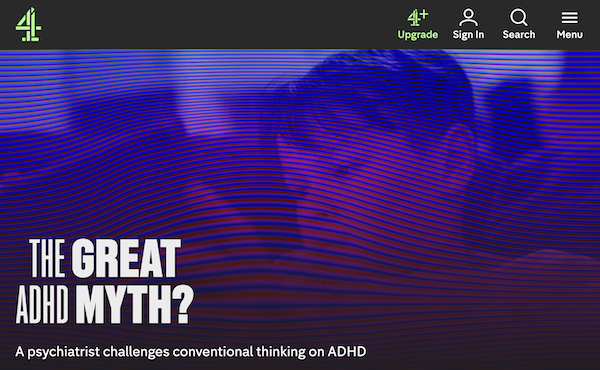
ADHD is recognised by the WHO and the NHS as a neurodevelopmental disorder, with a genetic component. There is a strong evidence base regarding these aspects of the condition, alongside the safety and efficacy of medication. In the United Kingdom there are strict guidelines for the diagnosis, medication and monitoring of interventions. The programme challenges this reality, instead portraying a populist perspective of ADHD medication being "demanded and dispensed". Its presenter concludes that ADHD is not a neurodevelopmental disorder at all, inviting an alternative interpretation - that instead it is a collection of behaviours arising from environmental factors, with the strong implication that medication is therefore an inappropriate response.
For reference, ADHD can qualify children for Disability Living Allowance, or Personal Independence Payment for adults, if severe enough, and it can meet the definition under the Equality Act 2010 S6(a), requiring reasonable adjustments at work or school.
A Foregone Conclusion?
Note - I'm adding the question mark to the title of this section to make it clear I'm asking a "legitimate question" and not crafting plausible deniability for an assertion. Hey, if adding a question mark is good enough for Channel 4...
Channel 4's press release, published ahead of broadcast, lays all their cards on the table.
While the traits of ADHD undeniably exist – the question is why they exist. Is ADHD actually a neurodevelopmental disorder? Do people with ADHD have differently wired brains? Or does our world – with phones, ultra-processed food, and regimented education system – serve as the catalyst for certain responses and patterns of behaviour? And with such uncertainty around the condition, should we really be giving children mind-altering drugs to treat it?
It's a bait and switch - each of these questions individually sound reasonable. Cumulatively, they're a leading trail of breadcrumbs.
Firstly, it establishes a baseline that we can all agree on, albeit considerably lower than the clincally-established and recognised baseline. These behaviours exist. We can observe, describe and categorise them well enough. It's not everything that clinicans account for in diagnosis, however.
Next, an either/or false bianry is offered. Either it's a neurodevelopmental concern, or it's environmental. I'd probably agree that modern life exacerbates impulsivity and distractibility. But these don't have to be competing hypothesis. Framing as "either/or" is a choice, when "yes, and..." is an alternative - if environmental factors make ADHD symptoms worse it doesn't demonstrate that ADHD itself is a "myth". It nicely moves from uncertainty about the causes to uncertainty about the condition. That let's them land the final blow: maybe we shouldn't be medicating.
We should exercise caution - there's an important difference between a question being unresolved in its details and the community at large being divided over the fundamentals. Science is full of open questions! This doesn't mean that all hypotheses concerning those questions have equal evidential support. A documentary that was "science-led" would lean into this nuance, instead of casting doubt on medication.
The next section of the press release concerns who takes part and how they're presented.
Dr Max Pemberton, a full-time NHS psychiatrist, is determined to find out. The documentary hears from a growing number of medical experts who are questioning the conventional narrative around ADHD, many of whom have been senior in the NHS.
Dr. Pemberton is not only an NHS psychiatrist, he's also an established journalist that writes for The Daily Mail, The Spectator, and previously The Telegraph and Reader's Digest. To be clear, there's nothing inherently wrong with a doctor being a journalist. Doctors can challenge prevailing practice, and they can hold opinions that differ from the consensus. His prior position is relevant - he is not a neutral presenter.
Dr. Pemberton has previously written that ADHD has gone from being relatively rare to affecting "every school neighbourhood and workplace", criticised what he described as the willingness to "whack people with a diagnosis"[2], and questioned whether the rise in diagnosis reflects medicalisation, providing a "neat and convenient"[3] explanation for complex reasons why a child might behave as they do.
In this programme, he states categorically:
"I'm now convinced it's a myth that ADHD is a neurodevelopmental disorder. Actually, I think it's a set of difficult behaviours, a social construct, not a disorder of the brain. People are really feeling these difficulties. We should not be medicating children so freely. These medications don't actually cure anything."
But he published the same view in December 2024. When someone has spent years publicly arguing a certain position and then presents a documentary concluding the same, the audience risks forming an incomplete and misleading picture of their relationship to the subject.
One Boy Does Not a Study Make
The programme spends a lot of time with a "carefully-monitored experiment" with an "independent doctor", in which a 10 year-old child comes off their medication cold-turkey and experiences a number of environmental-based interventions, such as yoga, time outdoors, dietary changes and reduced screen time.
One child undergoing such a wide range of changes isn't an experiment in the scientific sense. A single data point is an anecdote.
There was no control group[4], no randomisation, no blinding[5]. All this means there's no meaningful way to separate the effects of medication withdrawal from the environmental-based changes.
Channel 4 described this as a "science-led approach". It was not. It was an uncontrolled case study. There is no way to infer the underlying hypothesis.
Even on its own terms, the case study fails to demonstrate Dr. Pemberton's conclusion. At the end of the show, just before the credits, the following text appears on-screen:
2 months after filming, Mason continued to struggle at school and after some poor exam results Shauna made the difficult decision to put him back on his medication. Mason's school work has improved. He wants to come off the drugs again this summer.
Re-Airing Dirty Laundry
Call it a publicity blitz, but when a public broadcaster commissions a controversial programme, it gets further press attention.
Even sympathetic reviews recognised the programme was not a rigorous scientific investigation.
Lucy Mangan's 4 ⭐️ review for The Guardian describes it as a "stunt", and says she would have preferred Dr. Pemberton to "stick with the science" and examine the data more deeply.
James Jackson's 4 ⭐️ review in The Times acknowledges that, if judged as a dispassionate science film, "it would have been flawed by a lack of balance".
The programme can be acknowledged as polemical, provocative and inbalanced, yet both reviews ultimately validate the programme's conclusions, demonstrating the framing has already succeeded in the laundering - making it part of the public discourse.
Denial
When I formally complained to Channel 4 following the press release, but prior to broadcast, I received the following reply. Please note, this exact reply was sent to others who had complained, making it clear it is a blanket statement.
"Whilst we appreciate your concerns, please be assured that this documentary does not deny the lived experience of people with ADHD traits. The question posed by the programme is why they exist. It asks is ADHD actually a neurodevelopmental disorder, and do people with ADHD have differently wired brains? Or does our world – with phones, ultra-processed food, and regimented education system – serve as the catalyst for certain responses and patterns of behaviour?The programme hears from a group of senior medical and academic experts - many of whom work or have worked with the NHS or have held presidential roles at professional membership bodies.
Before and during production, the programme-makers met with a number of children living with an ADHD diagnosis and their families, alongside many and varied experts who expressed views across all sides of the discussion. We worked with many senior, accredited professionals across the medical field, with a variance of views on the topic, including, but not limited to, psychiatrists, psychologists, psychotherapists and neuroscientists. The film also hears from the former President of the Royal College of Psychiatrists and the former President of the Royal College of General Practitioners.
As with all Channel 4 programming, editorial responsibility rests with Channel 4. The programme was produced in accordance with Channel 4's Editorial Guidelines, established television practice, all relevant legal requirements as well as the Ofcom Broadcasting Code. Appropriate editorial processes and compliance checks were undertaken throughout production."
As reassuring as it is crafted to be, it's not. The response repeatedly appeals to credentials: senior medical experts, academic experts, NHS experience, accredited professionals, former presidents of professional bodies. Channel 4's response establishes there's disagreement in the programme, but not that it's represented proportionally to the weight of the evidence. The question is not who believes what, but what evidence supports those claims and how that evidence compares with the evidence supporting the alternatives.
False balance - presenting two positions as 'opposing' sides - can give the impression they have comparable weight, when they may not.
The programme's reception provides useful evidence about whether these concerns are merely hypothetical, or actually harmful.
Katya Rubia, professor of cognitive neuroscience at King's College London, withdrew her support, saying that her views had been misrepresented and cherry-picked to support the narrative. She was damning in the potential for harm:
"Parents of children with ADHD may take their children off medication as seen on the programme, which could potentially lead to an increase of the risk of longer-term adverse outcomes of untreated ADHD such as increased anxiety and depression, lower self-esteem, greater risk of substance abuse, suicide, more antisocial behaviour and poorer academic achievement … and reduced employment prospects later in life."
Channel 4 deny this accusation, but their denial tacitly admits the show was pushing a particular angle:
"A Channel 4 spokesperson disputed the claim that it denied the lived experience of those diagnosed with ADHD and instead sought to present the views of a range of senior medical experts who seek to question the conventional understanding of ADHD and if it is a neurodevelopmental condition."
If that is what the programme was designed to do, then taking a "science-led approach" describes the set dressing, not the methodology.
The Royal College of Psychiatrists[6] have published a statement heavily criticising the show for its contribution to the public discourse.
"The way we speak about neurodevelopmental conditions really matters. It can fuel harmful stigma experienced by people living with the condition and risk discouraging people from seeking the support and treatment they need."
Amnesty International heavily criticised the show, with their piece "When Denial becomes Debate"
The charity ADHD UK wrote to Channel 4 when the press release was published, and have since lodged a formal complaint with Ofcom [7] over the following aspects of its [Broadcasting Code]:
- Section 1 - protecting the under-eighteens
- Section 2 - harm and offence: "Due care must be taken over the welfare and the dignity of people under eighteen who take part or are otherwise involved in programmes."
In my complaint to Ofcom, I also referred to "Section 5 - undue prominence of views and opinions".
Why This Matters
People make decisions based on what they see and hear in the media. Whether to seek an assessment, or start or stop medication. There's still stigma surrounding neurodivergence and I'm concerned about that increasing because of this programme. The public will form views about whether healthcare institutions can be trusted; and trust is low, weakened by historical handlings of BSE, MMR and COVID-19 within the wider public discourse.
A broadcaster with a large audience has a responsibility that goes beyond presenting an alternative perspective. It needs to help viewers understand the difference between established evidence, legitimate scientific uncertainty, plausible but unproven hypotheses, and claims where the evidence is weak, or contested, or even entirely lacking. A genuinely useful documentary could have explored all of that. Instead, we got this. A very different proposition, that deserves considerably more scrutiny.
Do better.
Disclosures and whatnot
I have no medicial or journalistic qualifications - my degree is in Computer Science! I do, however, have lived experience of the issue as a parent of a young child who has received an ADHD diagnosis through a service operating according to NICE guidance and recognised by the NHS. At the time of writing, my child is currently not medicated and is awaiting treatment. Additionally, I also have experience organising and speaking at community events on the topics of disinformation in the media. I mention this because transparency about perspective matters... something the programme-makers failed to do.Channel 4 are a publicly-owned but not publicly-funded UK TV broadcaster ↩︎
same article ↩︎
Daily Mail, September 2025, don't read the comments ↩︎
another set of children who received the same set of interventions, but without changes to their medication ↩︎
reducing the likelihood of facilitator bias by obscuring which group received which interventions ↩︎
The RCPsych is the professional body of psychiatrists in the United Kingdom ↩︎
Ofcom are the UK statutory media regulator ↩︎