December '25 Monthly Review
Right, good grief, that's another year all done with. Happy New Year and all that. This is the twelth post of my series of monthly review posts for 2025. Other entries in the series:
- January 2025
- February 2025
- March 2025
- April 2025
- May 2025
- June 2025
- July 2025
- August 2025
- September 2025
- October 2025
- November 2025
December's been a surprisingly difficult month for me and ended up being rather exhausting.
Work
Oh man, December has been all over the place at work. It's end of year, which means performance reviews - with both ends of the spectrum of conversation. A few months back Platform Engineering moved from the Operations part of Technology into the Engineering part, which I supported at the time. But it means that there are some different expectations around how we now operate, especially those of us who sit in the Centre of Excellence and work across all of the teams. As a Principal in Operations it was fairly lonely at times. I had my area, and I worked it to the best of my ability with my Leads. But it meant that my ability to have the organisational-level impact a Principal role requires was at times constrained by the organisational model. That's different now and I'm still figuring out how to best leverage the new position.
It's also been a bittersweet month as some colleagues have left for new opportunities. I'm sad I'm not working with them anymore, but I can confidently say the moves will bring them success.
In terms of the technology, I'm starting to work with some of the other Principals around test engineering and CI/CD as we look to standardise and modernise our approaches. This is work that I've wanted to do for years, and I'm thankful I'm in an influential position at the time where we get to do it.
Christmas
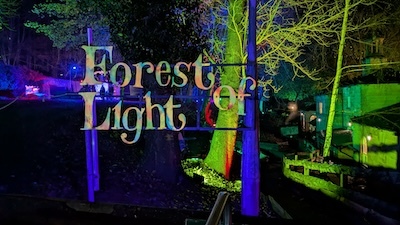
As is our now annual tradition, the family visited The Forest of Light, at Beamish Hall. This is our fifth year in attendance. It's great to see both of the kids excited as they wander the trail. If you haven't been before, do go, as it's a phenomenal display.
Both children had school nativities - the youngest taking part in our now fourth iteration of Wriggly Nativity (good thing the kids like the songs and listen to them in the car!), and the eldest in Baarmy Bethlehem. They both performed very well, especially the youngest, as last year he was overcome with stage fright.
We enjoyed a fabulous trip to Cragside, a National Trust property in Northumberland. It is advertised as the "world's first smart home" - it was built by Lord Amstrong and used hydropower for its electrical supplies. Inside, they'd splendidly decorated the building. Outside, they'd turned one of the (incredibly large) Redwoods into the World's Tallest Christmas Tree. It's lovely any time of the year, but the combination of the setting and the decor made it a magical experience.
My Mother-in-law joined us for Christmas this year, so we got to share our traditional Christmas Eve curry, and our Christmas pudding, which was a festive-themed Colin the Caterpillar cake. The kids enjoyed their presents: Santa was very good to them. I got a Lego Game Boy - finally putting an end to a 36 year wait for a Game Boy for Christmas!

I've spent a lot of the Christmas holidays just knackered, without even doing anything. I think it's a bit of a come-down. Work has been full-on for a long time. Even my running has suffered from the lethargy, getting motivation to get out, and then doing anything more than a couple of miles, it's just painful. I've tried my best and haven't put on any weight, so it's still a win. I entered the annual Pudding Run - a coastal 5k fun run on Boxing Day - but didn't make it as we decided to take the kids out instead. Next year, the North Tyneside 10k is back to its usual Easter slot, so perhaps that's something to gear up to...
Media
With having half the month off work, it's time to get the warm hoodies on and consume some #content.
In addition to the below, I finally completed Donkey Kong Bananza 100%, including the post-game, all the Bananas and the Fossils. What a fantastic game!
At the time of writing, I haven't finished watching Season Five of Stranger Things, so that will have to wait for next time...
The Goes Wrong Show by Mischief Comedy
From the folks that brought you The Play That Goes Wrong. I want to call out three episodes in particular that have become an annual family tradition.
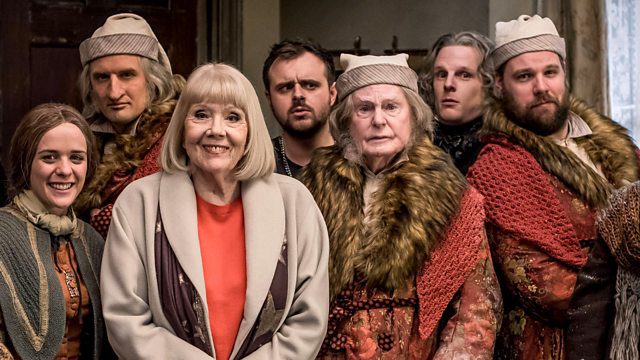
A Christmas Carol Goes Wrong has the Cornley Drama Society impose themselves upon a professional production of A Christmas Carol, and struggle to keep hold of the storyline. As the crew compete over who's who, the original cast plot to regain control of the broadcast. Professional faces including Derek Jacobi and Diana Rigg join the fun.

The Nativity is a retelling of, well the Nativity, sponsored by Brookshaw Corporate Finance. Both my children loved the slapstick humour in this one. The angel Gabriel on his cherry-picker, with fireworks. King Herod's spinning chair. Fire alarms and the ~three~ nine wise men. Brilliant!

The Spirit of Christmas is my favourite of the three Christmas episodes - it's an original story about love, family and the magic of Christmas. There's elves, a snowman, a reindeer, Santa, and some sherry. What can possibly go wrong? Pretty much everything. The snowman and the toy machine, no matter how many times I've seen it, is still a fantastic belly-laugh-out-loud moment and pure joy.
"You're having a shocker, Chris!"
Smartphone Nation by Dr. Kaitlyn Regehr
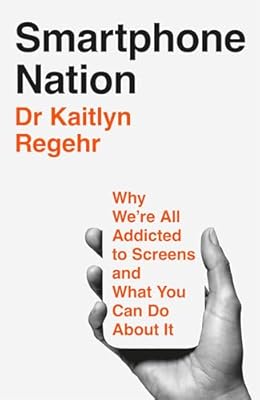
The subtitle Why We're All Addicted to Screens and What You Can Do About It explains the message of this book, which acts in a dual role of a polemic on the attention economy and self-help on how to resist the urges for the attention fix:
Our attention – or rather, our mind – is the product.
An interesting quip worth bearing in mind:
A term which as computer scientist Edward Tufte has pointed out is only found in two industries, tech and the illegal drugs trade: ‘user’.
I don't want to focus on what I'd say are the fairly conventional anti- screen-time arguments. They're made well enough but you've probably heard them a million times by now. Which is not to say they're irrelevant, we all have more we can do. Let's cover the more interesting stuff.
Sharenting
Dr. Regehr writes much about the concept of 'sharenting'. When my wife and I began talking about children, we made an explicit decision to not allow pictures of our kids on social media. And by and large, we've been successful on this. Most pictures out there aren't of their faces. We decided to do this for our reasons. The concept of sharenting is the opposite, the oversharing of photos and videos of their children. Over time, in aggregate, this is a treasure trove of data that can later been exploited. With Australia recently enacting a Minimum Age on Social Media, and talks of similar in the UK (where we already have the Online Safety Act that's came into force), and various campaigns kicking round for 'phone-free' schools, this is now in the public discourse.
People my age spent our teens on social media platforms who have come and gone, along with their data. The MSN Messengers and emo Myspace profiles are basically forgotten history. It wasn't until the late 00's when Facebook and Twitter began to dominate, roughly around the time that camera phones (and then iPhones and Android smartphones) image/video quality became 'good enough', and the sharing workflow was accessible enough for widespread adoption. The first wave of 'sharented' kids, who've grown up in a pervasive social media environment, are becoming adults now.
What's the risk?
According to Barclays Bank, there are three key pieces of information used in identity theft: a person’s name, date of birth and home address. These can be deduced through sharenting by way of photos or updates on social media accounts
Disinformation
Back in early social media you were shown a reverse-chronological list of content specifically from those you followed. It was fucking great. Then the adverts were interspersed in, to 'monetize' the service. As providers cottoned on to the goldmine they were sitting on, they explored algorithmic curation of feeds: surfacing the most 'engaging' (whatever the hell that means) content, both from your network and adjacent to it.
It's fair to say that there have been profound consequences to this:
One of the most pervasive harms to our contemporary society is known as ‘truth decay’. The term was coined by the Rand Foundation in 2018 to describe the undermining of evidence-making.
Posts 'shared' by acquitances carry a token of endorsement (as much as people try to defend with 'RTs are not endorsements') - the fact that someone has chosen to share something has intentionality behind it. This is the simple case. Some social networks will also silently share with your network your other platform activities, such as commenting or liking on content. It's this action that makes LinkedIn's Activity Feed a polluted bin fire and why you end up seeing pictures of kids that you don't know enjoying their bathtime on Facebook (it's because your sister's commented 'aww cute hun x'). But it's also how disinformation spreads and how new norms build up.
The narrative around Brexit, perhaps not seeded organically, but certainly spread through the network effect. We see the same with the small boats rhetoric now, or the other far-right talking points (London's a 'no go' area) etc. It's how suddenly you'll be driving down a road one day and there'll be fucking flags everywhere, as if a miasma of nationalism was blown through the streets of <insert deprived local town here>. The common truths that we agreed as a wider culture have splintered into smaller cells of factional truths. And it's hard to go against the grain when it's all your mates and their mams and dads and racist uncles saying the same thing.
The Genius Myth by Helen Lewis
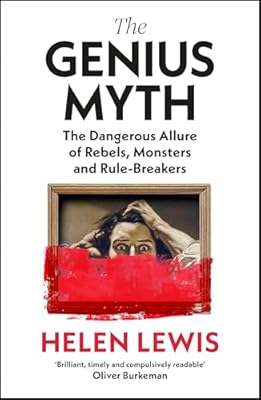
In a world where we have a 'genius' who's been characterised as a real life Iron Man, and who was fawned over before becoming the World's richest ~man~ arsehole, doing a Nazi salute (twice) at a Trump rally, buying Twitter and turning it into a platform that amplifies fascist voices; Helen Lewis takes on the myth of the genius.
The deification of the genius in our culture and history is a curious one, and it often warps those who carry the title.
Think of terms like "it's not rocket science", or the notion of Einstein as shorthand the pinnacle of human intellect. Lewis rightly points out that Einstein himself was outpaced in the fields he helped pioneer and popularise. But there's this idea that a genius isn't just spectacular in their domain, but in all:
Then, as now, there is an assumption that superior knowledge and expertise in one domain confers authority in others. It is one of the worst outcomes of the mythology of genius, because it encourages exceptional people to stray far outside their competence – to see themselves as omni-experts, superior minds who have much to contribute on any issue.
Looking through history, there are scores of individuals who are renowned for inventions, discoveries and revelations. Lewis wonders what will happen in the future, especially in the Sciences, where discoveries are increasingly international collaborative exercises. Will we get geniuses in the future? I mean, probably, but not necessarily in the same way as the Enlightenment era Big Name Scientists.
But let's track back to how the label itself perverts the labelee. How a 'headstrong' individual who challenges established praxis may bring about the antithesis to the dominant thesis:
‘Galileo syndrome’. His story is one of the earliest examples of the myth that if everyone is telling you that you’re wrong, it will be all the sweeter when you are proved right.
But the effect on the individual, spurred on by their champions, when they descend into crank theories:
This is the dark side of the mythology of genius: it makes a fetish of contrarianism, and flatters the ‘free thinker’ or ‘heterodox intellectual’ into moving from scepticism to conspiracism.
Remind you of anyone?
There's a healthier perspective, in conclusion, and one that centers the artefact over the individual. I like this.
I wish that we would move back to the ancient idea of genius, something that is found in particular actions, or specific works. To me, it makes more sense to call, say, a particular painting genius than pin the label on the person who created it.
Malevolent by VJ Nash

I liked this one. Blending a decent mix of cosmic horror with British police procedural urban fantasy, Nash's story flows well and sets up a series nicely. There's a serial killer who is murdering (rather brutally, it must be said) members of a cult, or so he claims. DI Ennis finds out rather quickly that the case is taken off his hands, by some unknown Government sub-department of the Treasury (of all places), who seem to just ... let it slide. As he digs further, his family life - specifically, his neurodivergent and psychically-aware daughter and his wife - comes into conflict with this work life.
Interestingly, it seems the 'main character' of this book (or at least from whom the vast majority of the POVs are from) is not the series main protagonist. That's Elizabeth Russell, the head witch of the Treasury, who is a badass character. She's a character who's powerful, and has done the work to get there. Having her not be the point-of-view character is a great way of introducing someone higher up on the power curve, without it feeling forced, or doing an origin story.
Not only was the baddie creepy, but the supporting characters were. The serial killer, and then also the cult goons. I'll definitely pick up the next in this series.
Stranger Things: The Other Side by Jody Houser
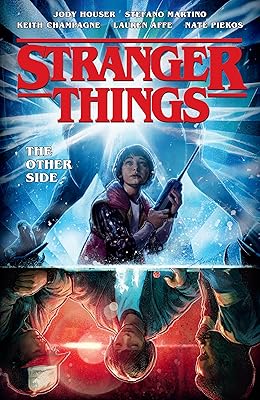
A graphic novel set in the Stranger Things universe, this tells "The Other Side" of the story, from Will's perspective, following his kidnapping by the Demogorgon in Series 1. It's about how Will survives in the Upside Down. Nothing in this contradicts what's in the mainline show, although there's some stuff retconned in with Series 5. Passable.
What's Next?
As we enter the second quarter of the 21st Century (yeah, you're getting old), it's customary to make some resolutions. I don't think I'm ready to do that and I won't let some arbitrary marker around the Sun define me. Bloody Romans, it's always their fault.
Will I continue this series? Not sure. It's the second full year of doing a monthly roundup, and it's good to flex the writing muscles in a more casual context. That said, when there's months where I haven't produced anything public-facing, whether that's a blog, or a talk or whatnot, it's felt more of a job at times. We'll see if the hunch is a signal to pivot, or noise encouraging a regression to a lazier position. Please do write in if you have any ideas.